
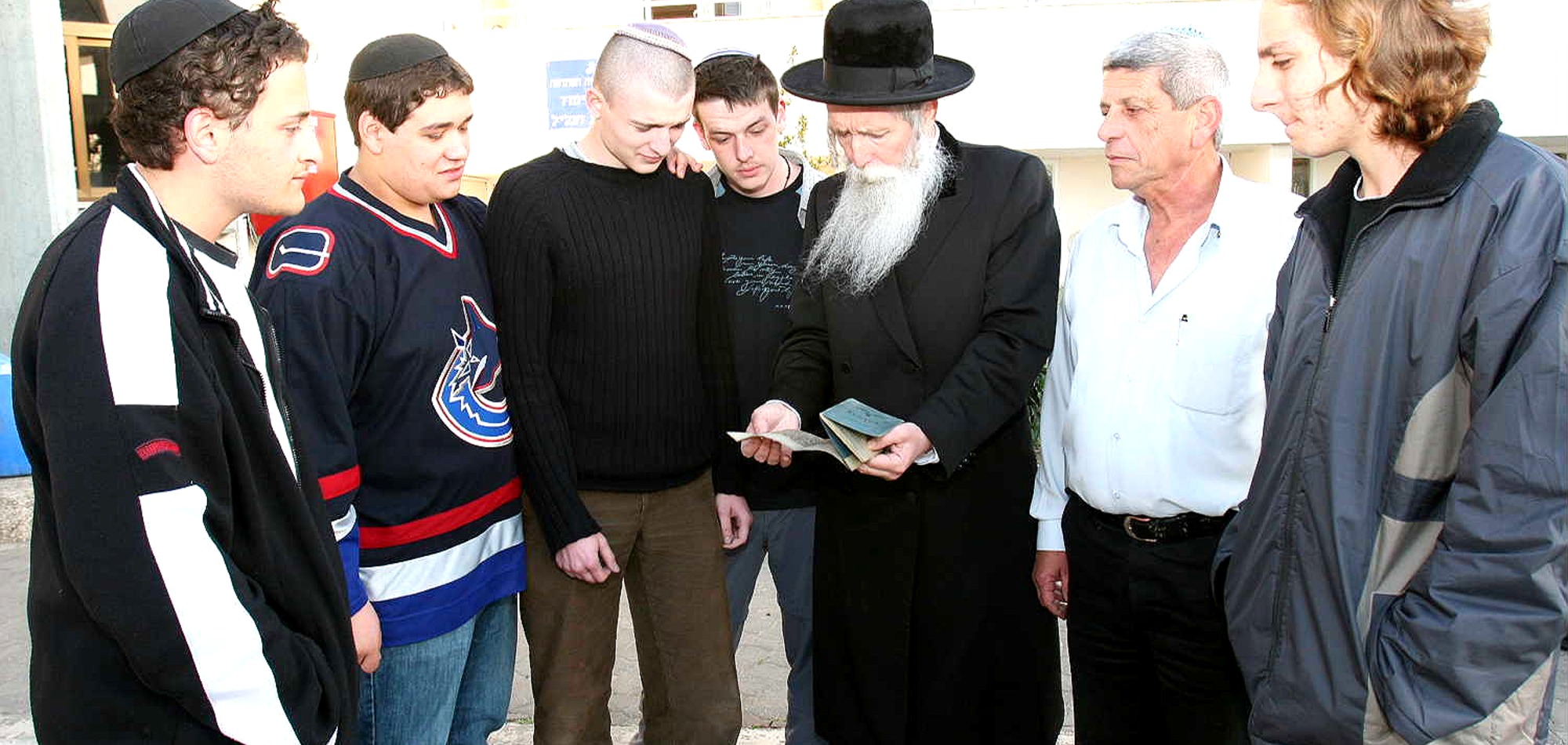
A small piece of parchment, torn from a Torah scroll during the Holocaust, now rests in the hands of Rabbi Yitzhak Dovid Grossman, founder and dean of Migdal Ohr.
Its journey to Israel took nearly 70 years.
The fragment was ripped from a Torah scroll by a Nazi soldier after he participated in the burning of a synagogue on the Russian front during World War II. The soldier used the parchment to wrap and preserve his military identification booklet, carrying it with him for decades.
Years later, shortly before his death, the soldier, Werner Herzig, revealed the secret to his son.
According to Moti Dotan, Head of the Lower Galilee Regional Council, the son approached him during a visit to Germany and shared the story.
“My father died a few weeks ago,” the man said. “Before his death, he told me that he fought in World War II and took part in burning a synagogue. He wanted me to know because today there are people who deny that it ever happened.”
Before he died, Herzig handed the identification booklet and the Torah parchment to his son with one request: to find Rabbi Grossman in the Galilee and deliver them to him.
Dotan eventually brought the items to Rabbi Grossman in Israel.
“When Rabbi Grossman received the parchment, tears flowed from his eyes,” Dotan recalled.
Turning the fragment over, Rabbi Grossman discovered that the surviving section came from the book of Deuteronomy, from the Torah portion Ki Tavo. The verses included words of warning and exile:
“And the distress which your enemies will inflict upon you… Then the Lord will bring upon you and your offspring uniquely horrible plagues…”
These verses, known as the verses of admonishment, speak of suffering, destruction, and the consequences of abandoning Torah.
For Rabbi Grossman, the fact that these exact words survived was no coincidence.
“After 60 years, this parchment arrived in Israel wrapped in these words to awaken us,” he said. “The soldier could have cut parchment from anywhere in the Torah, yet specifically these verses remained.”
Every year on Yom HaShoah, Rabbi Grossman presents the identification booklet and parchment to his students at Migdal Ohr.
“It gives them goosebumps,” he says. “This is not history in a textbook. It is something you can see with your own eyes. You see the embodiment of evil, how someone could destroy a synagogue and then cut a piece from a Torah scroll simply to protect his ID card.”
But for Rabbi Grossman, the story does not end with destruction.
“G-d always has a bigger message,” he says. “He is always teaching us, and calling us to come home.”
Today, what was once an object of desecration has become a living lesson in memory, faith, and Jewish survival.
Adapted from an article by Aryeh Savir via Tazpit News Agency.
.png)

.jpg)
.jpg)